
Clarke Court Release Records
Clarke County courts are legal-record sources, not detention facilities. A bond order authorizes conditional pretrial release. A dismissal or nolle prosequi order addresses a charge. A judgment may impose time served, probation, a county sentence, or commitment to MDOC. Revocation and amended orders can change the result later. Each document explains authority, but the sheriff or other custodian records the actual departure time and destination.
That distinction prevents a common error. A judge can authorize release while another case, warrant, detainer, or administrative step keeps the person in custody. A commitment order can also cause someone to leave Clarke County Jail for MDOC without returning to the community. The court file and movement record must be read together.
| Court record | What it can show | What it cannot prove alone |
|---|---|---|
| Bond order | Terms of conditional pretrial release | Exact jail exit time |
| Dismissal or nolle prosequi | Disposition of a charge | Absence of another hold |
| Judgment and sentence | Time served, probation, jail, or MDOC commitment | Custodian's actual movement |
| Revocation or amended order | Later change to the legal status | Present location without a custody check |
| Termination order | End of a probation or supervision term | Earlier release date from confinement |
Clarke Court Release Jurisdictions
Do not search only Circuit Court. Clarke Justice Court hears county ordinance and DUI matters and conducts initial felony appearances. A felony may then be bound over or indicted in Circuit Court. Municipal charges can remain in the relevant city court. The correct clerk depends on where the case was filed and which judge issued the release-related order.
The official county court material provides a notable local cadence: Justice Court judges conduct sessions at the jail three times each week to help ensure an initial appearance within three days of arrest. That can produce a bond or other early order. It is not a fixed release schedule, and the order still does not establish the physical exit time.
- Initial appearance
- An early hearing addressing the charge, rights, and possible custody terms.
- Recognizance
- Release based on a promise to appear, subject to the court's terms.
- Nolle prosequi
- A prosecution entry declining to continue a charge at that point.
- Remand
- An order returning or keeping a person in custody.
Search Clarke Circuit Release Orders
Clarke County is in Mississippi's Tenth Circuit. Public viewing uses PAMEC, and the official login page says people who only need to view filed documents or case information need a PAMEC login. Registration is available online. Some cases or documents can remain restricted, so an empty result is not proof that no case or release exists.
- Identify the case number whenever possible; otherwise use the exact legal name and verify identity.
- Open the docket and locate the bond, dismissal, plea, judgment, sentence, commitment, amended, revocation, or termination entry.
- Read the underlying document rather than relying on a short docket code or flag.
- Note the date, court, case number, and exact action.
- Pair the order with the sheriff, MDOC, BOP, ICE, or USMS movement record that fits the destination.
The Tenth Circuit PAMEC login documents the access requirement. The source capture below preserves that official starting screen.
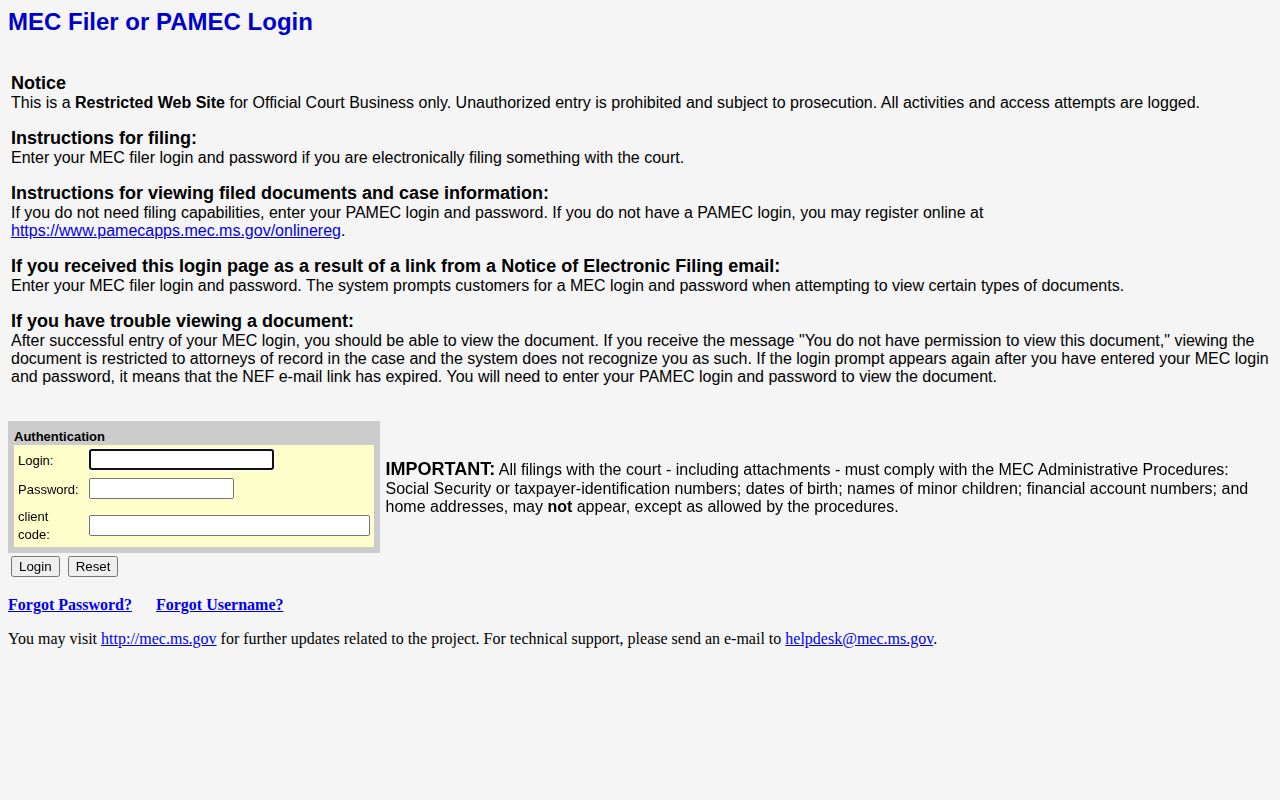
The login route supports circuit-case viewing. Justice and municipal matters may require their own clerks.
Read Clarke Court Release Flags
The Clarke Circuit MEC legend includes CLOSED, EXPUNGED, SEALED, Nolle Pros Pending, Probation, Probation Viol Pend, PRS Viol Pend, bench-warrant states, and lower-court appeals. These labels describe case administration or legal status. They are not body-location fields.
CLOSED does not mean the person left jail on that date. Probation does not identify the exact departure time. A pending probation or post-release-supervision violation may lead to new custody, but the flag alone does not show the final ruling. Expunged and sealed flags limit public access and must be respected.
The official Clarke MEC information page provides the court details and legend used here.
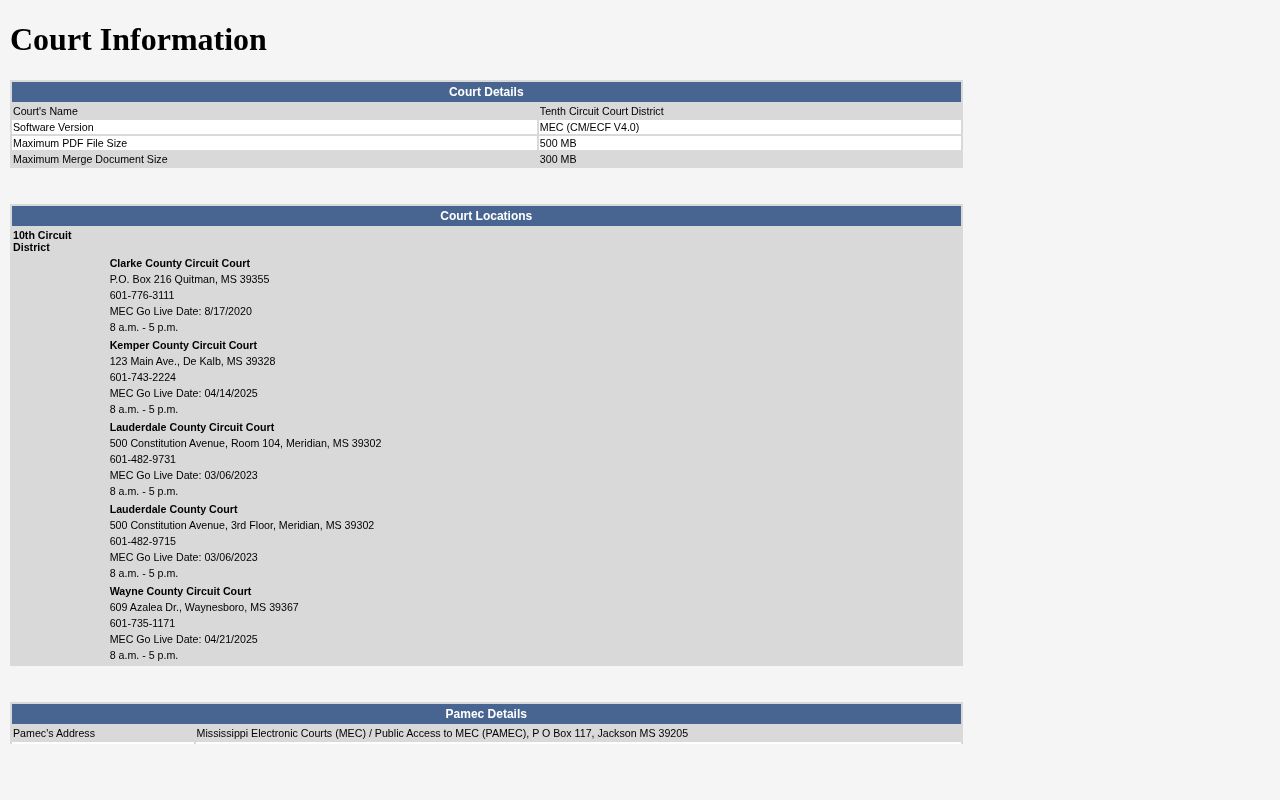
The flags create a useful legal trail after a live custody list changes, but the underlying order remains essential.
Note: A case-status label should be paired with the filed order and the releasing agency's movement record.
Request Clarke Court Release Records
For a circuit matter, request the docket sheet, charging instrument, bond or appearance order, dismissal or nolle prosequi order, plea, judgment, sentence, commitment, amended order, revocation order, and any probation or post-release-supervision termination. Give the case number and name. Ask for the specific filed document rather than a verbal summary.
Sally Wedgeworth
101 South Archusa Avenue
Quitman, MS 39355
Phone: 601-776-3111
Fax: 601-776-1001
Public hours reported by Tenth Circuit MEC: 8:00 a.m. to 5:00 p.m.
The official Circuit Clerk page says the clerk receives and files criminal-case papers and keeps judgments and executions. For Justice or Municipal Court, contact the originating clerk. The official Courts page has inconsistent phone prefixes in some body text, while its footer and the separate clerk source use 601. Verify a number before travel instead of silently correcting the source.
No universal court-file access result is promised. Sealed, expunged, juvenile, victim, or otherwise restricted material may be unavailable or redacted. Court records also operate under judicial access rules, not simply the executive-agency Public Records Act process.
Confirm Clarke Court Releases
After locating the order, identify the custodian named or implied by the case. If Clarke County Jail held the person, call the sheriff at 601-776-5252 and ask for the actual release date, time, disposition, and destination in the jail docket or booking-release entry. If the judgment committed the person to MDOC, the state transfer is continued custody and the MDOC record becomes the next source.
Federal and immigration routes require the matching federal system. A federal judgment and BOP locator may apply to a sentenced prisoner. A federal detention or release order and the actual holding facility apply to USMS pretrial custody. If the sheriff records an ICE transfer, use ICE's locator or ERO inquiry. The Clarke County release-record workflow places those records in sequence.
Clarke Sentence Completion Records
Sentence completion can involve more than one agency. For a local sentence, use the Clarke judgment, any credit-for-time-served term, and the sheriff release record. For a state sentence, MDOC calculates dates and produces release or discharge documentation. For federal imprisonment, BOP supplies the federal agency release date while the judgment explains any later supervised-release term.
A probation termination order does not retroactively establish the date of an earlier jail exit. Likewise, parole eligibility or a tentative state date is not a court-confirmed release. Keep the legal action, agency calculation, and actual movement as separate fields in the record trail.
Mississippi expungement is case and disposition specific. Release does not automatically expunge a case or booking record. Absence from PAMEC may reflect sealing, expungement, a lower-court case, name differences, or no match. It should never be used to infer the outcome.
About Clarke County Courts
The mapped Clarke court system includes Circuit, Justice, and municipal records. It is included among release sources because a legal order often outlasts a short-lived custody display. The system does not confine people and should not be described as a jail, roster, or release feed.
The court file answers the legal-basis question. The sheriff, MDOC, BOP, ICE, or USMS answers the movement question. When both match, a release or transfer can be stated with much greater care. When they conflict, contact the issuing clerk and actual custodian rather than choosing the more convenient result.
Clarke's official court sources also require care with contact details. The county Courts page contains inconsistent telephone prefixes in some entries, while the separate Circuit Clerk page and MEC information support the 601 number used for circuit access. A caller should state the court and case type, verify the number, and ask which clerk holds the requested order. That small check is especially useful when a case began in Justice Court but later moved to Circuit Court.
For a named person, preserve the case number, filed date, and exact title of each order. Those details let the sheriff or later custodian match the legal event to the correct movement. They also reduce the risk of mixing two people who share a name.