
BOP Release Records Near Clarke
The Federal Bureau of Prisons is the federal prison system. It does not operate the Clarke County Jail, and no BOP institution was identified in Clarke County. A local arrest, county booking, or MDOC sentence should not be searched through BOP unless federal custody is independently plausible.
BOP says its public locator includes information about federal inmates released after 1982. Older records may require National Archives research. The database may also include people who were in BOP custody without serving a federal sentence, including some pretrial detainees, material witnesses, or people whose charges were dismissed. A hit proves neither conviction nor a Clarke County connection.
Search BOP Federal Releases
The BOP Inmate Locator is the public starting point. A register number is the best key. A name search requires close comparison of age, race, sex, and any known federal case information. Similar names should not be treated as one person.
- Choose the register-number route when the federal identifier is known.
- Otherwise search the exact name and compare every displayed identity field.
- Read the location and release-date fields together.
- Distinguish RELEASED, a future date, UNKNOWN, and IN TRANSIT.
- Open the federal court judgment to identify the sentence and any supervised-release term.
- Use BOP FOIA or archival research when the public result does not cover the needed period or detail.
The source capture below comes from the official locator and demonstrates the federal search route for an identified federal case.
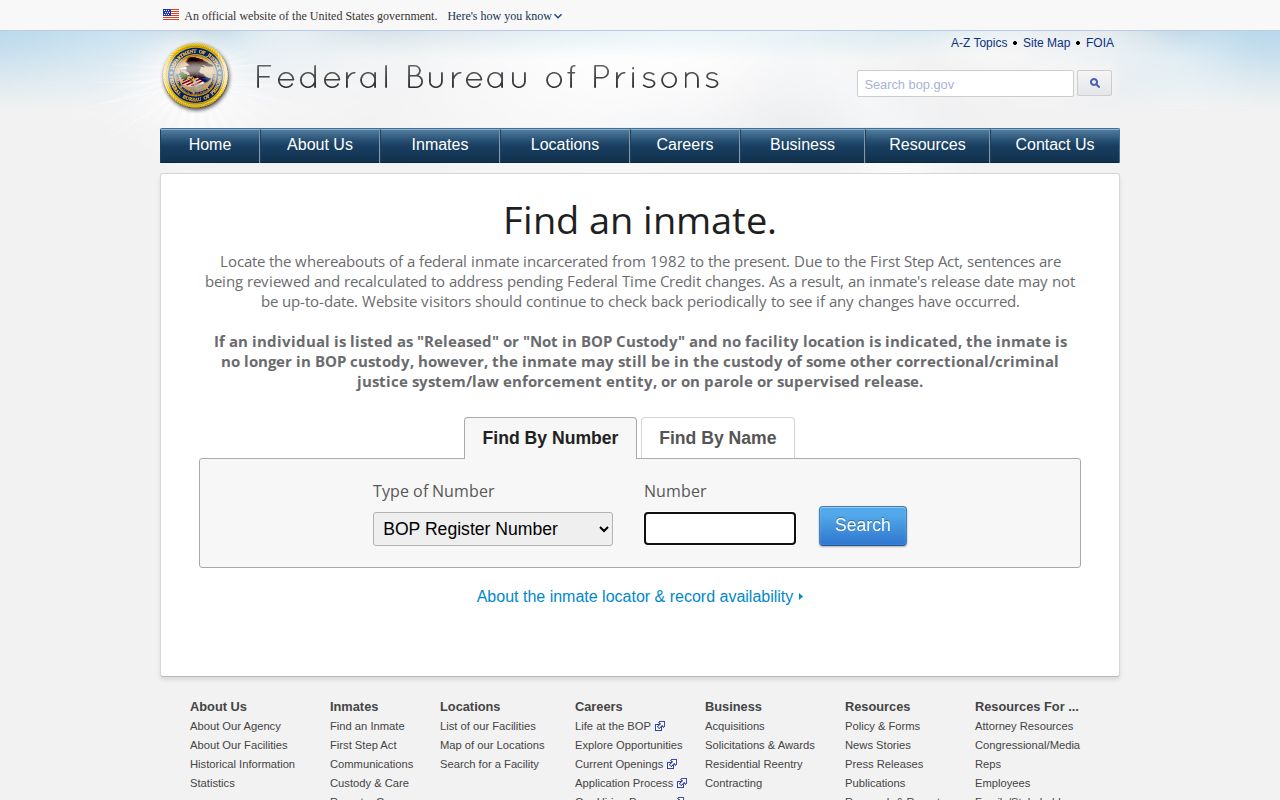
The locator is useful only after the person is tied to federal custody through a case, identifier, or reliable custodian record.
Read BOP Release Result Fields
BOP defines its displayed fields as name, register number, current age, race, sex, release date, and location. The locator is updated daily. Those fields help distinguish people and interpret the agency's present or past custody statement.
| BOP display | Supported meaning | Needed follow-up |
|---|---|---|
| Past date and RELEASED | No longer in BOP custody on the shown date | Check court supervision and other custodians |
| Past date and no institution | BOP reports release from its custody | Confirm destination if another hold was possible |
| Future release date | Projected BOP date | Recheck the live record near the date |
| UNKNOWN | Confinement term is undetermined | Use the judgment and BOP records |
| IN TRANSIT | Movement within custody | Do not call it release |
The official explanation of BOP records is the source for these meanings.
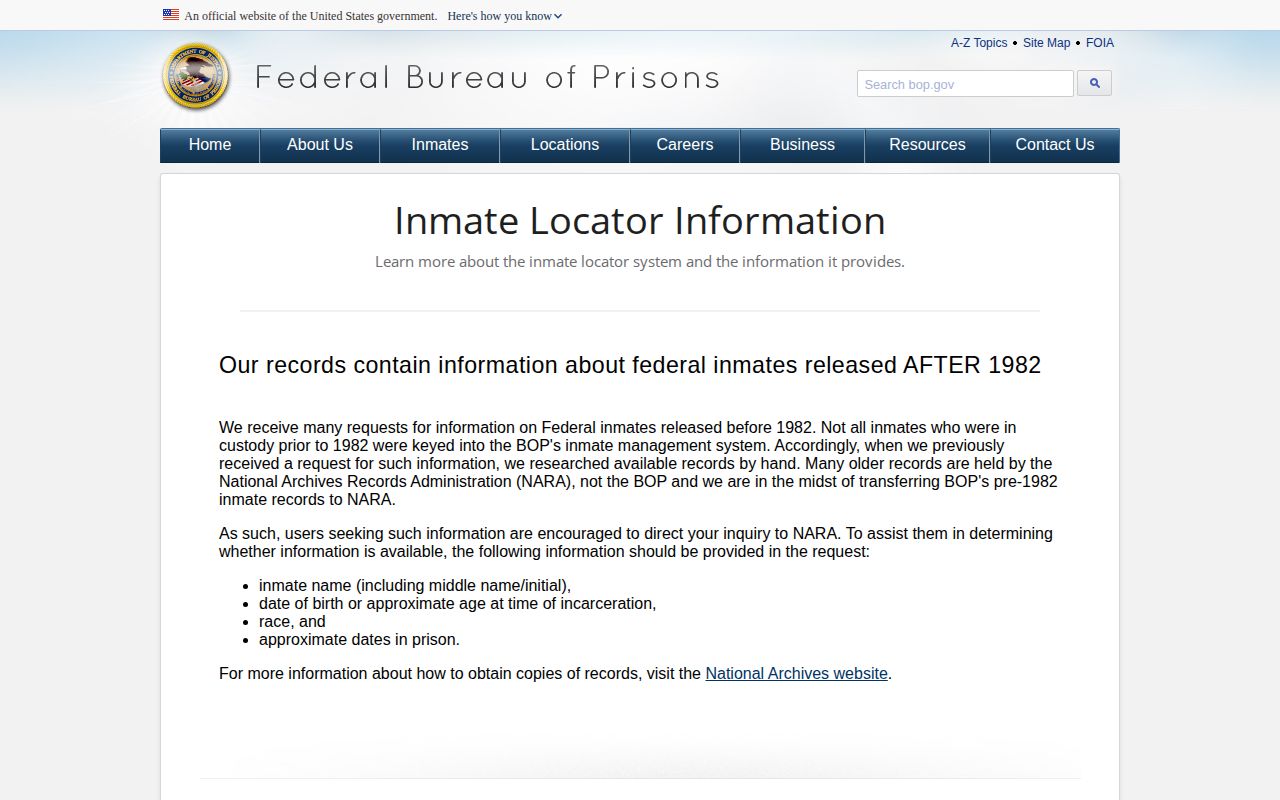
The explanation keeps RELEASED tied to BOP custody, rather than turning it into a claim about every government system.
Note: Record the register number and access date because a name alone is a weak link between a person and a federal result.
BOP Release and Federal Supervision
“No longer in BOP custody” is deliberately limited. A person may remain on federal supervised release, enter state custody, face an immigration hold, or move to another sovereign. The federal judgment states any supervised-release term. The BOP locator does not replace that document.
A detainer is a request or hold from another authority. If a state warrant or immigration matter existed, the BOP release event may be a handoff. The location field and court docket can point toward the next agency, but a complete confirmation may require the receiving custodian's record.
- BOP release
- Departure from Federal Bureau of Prisons custody.
- Federal supervised release
- A court-ordered community term that can follow imprisonment.
- Detainer
- A hold or notice from another authority affecting custody movement.
- Register number
- The federal identifier used to distinguish an individual BOP record.
Clarke County to BOP Custody
No evidence reviewed establishes a BOP facility in Clarke County or a routine local federal prison program. The BOP path is a contingency route. Use it when the sheriff's destination notation, federal charge, U.S. District Court docket, USMS movement, or register number shows federal involvement.
A person can appear in a local facility during federal pretrial custody without ever serving a BOP sentence. USMS uses federal, state, local, and private beds for pretrial placement and transport. If the person was released before a BOP sentence, the federal court order and actual holding facility are stronger sources than a blank BOP search.
After federal conviction, USMS ordinarily delivers the sentenced person to the serving institution. BOP then becomes the correct locator. Keeping those stages separate avoids calling a pretrial remand a prison admission or a transfer a community release.
Request BOP Federal Release Records
Use the public locator for a current or post-1982 public result. For more documentation, use the BOP Freedom of Information Act route. The official material notes that identity or certification may require the DOJ-361 process. Ask for the specific federal custody episode and include the register number.
Public locator: BOP Inmate Locator
Historical or fuller record: BOP FOIA
Older federal custody: National Archives research may apply
Public service hours: not stated in the Clarke research
A focused request should identify the person, register number, approximate custody dates, release date sought, location history, and any transfer or destination field that is releasable. The federal docket can supply the case number and judgment. It can also explain whether supervised release followed imprisonment.
BOP FOIA and a court docket answer different questions. The agency record concerns custody and movement. The judgment concerns sentence authority. Neither establishes a county-jail release unless the Clarke sheriff record separately ties the person to local custody.
Confirm a BOP Federal Release
A strong confirmation begins with a matching register number and a past BOP release date. Read the location and status. Then check the federal judgment for supervised release and the docket for later detention or warrant activity. If another custodian is named, follow that destination.
For a possible Clarke County handoff, ask Sheriff Anthony Chancelor's office for the jail-docket actual release time, disposition, and destination. The researched sheriff contact is 601-776-5252. A notation showing USMS or another federal receiver should lead to that agency before BOP is assumed.
The Clarke County released-person record chain helps separate county departure, federal transfer, BOP release, and later supervision. One status should not be allowed to stand in for all four.
About the BOP Federal System
BOP is a sentenced federal custody system and public record source. It is not a Clarke County facility and not a locator for MDOC, ICE, or all USMS pretrial cases. Its daily locator is valuable because it can preserve a past federal release date for covered records.
The narrow meaning is also its chief limit. RELEASED means release from BOP. A future date is projected. IN TRANSIT remains custody. UNKNOWN lacks a set confinement term. When the exact destination or legal status matters, use the federal court and agency records that surround the locator entry.
Older federal records need a different path. BOP says public locator coverage generally reaches people released after 1982, while earlier federal custody may require National Archives research. Before making that request, collect the exact name, likely custody dates, court, case number, and any register number found in the judgment or later record. The archive question is then tied to one federal episode rather than a broad name search.
A public locator record can also reflect custody that did not end in a federal prison sentence. Some pretrial detainees, material witnesses, and people whose charges were dismissed may appear. Read the federal docket before describing why BOP held the person. The custody entry and court outcome are separate facts.
For a Clarke connection, the local destination field remains the bridge. If the sheriff record names USMS rather than BOP, follow USMS and the federal docket first. If a later BOP register number appears, the sentenced-custody path is supported. If ICE is named, use the immigration system instead. Precise routing prevents a federal label from hiding the actual agency.