
Clarke Parole and Probation
Mississippi separates the authority that orders supervision from the office that carries it out. Probation is a court-ordered community sentence or part of a sentence. Parole is conditional release that the Mississippi State Parole Board may grant to an eligible state prisoner. MDOC community-corrections agents supervise both groups, along with some people on other qualifying statuses. Eligibility does not mean parole was granted, and a person who left Clarke County Jail on bond is not thereby a parolee or probationer.
The controlling record matters. A Clarke court judgment or probation order explains a probation term. A Parole Board decision establishes parole authority. The MDOC Parolee Search can then help confirm that a supervision relationship is publicly listed. None of those records should be treated as the exact moment a person walked out of a jail or prison. The custodian's release or discharge record answers that separate question.
| Point | Parole | Probation |
|---|---|---|
| Source | Mississippi State Parole Board decision | Court judgment or order |
| Custody context | Conditional release from a state sentence | Community sentence or suspended portion ordered by a court |
| Supervision | MDOC community corrections | MDOC community corrections when supervised |
| Best proof | Board status plus MDOC supervision record | Judgment, docket, and supervision record |
- Discharge
- The formal end of the controlling custody or supervision obligation.
- Absconder
- A person alleged to have stopped required contact or left an approved supervision setting.
- Detainer
- A request or hold from another agency that may affect custody or release.
- PRS
- Post-release supervision imposed as part of a Mississippi sentence.
Verify Clarke County Supervision
Start with the MDOC Parolee Search. It accepts first name, last name, MDOC ID, city, and county, so Clarke can be used as a location filter. An ID is the strongest search key. With a name, compare every available identifier before relying on a result. A match supports a current published supervision relationship, but it does not show the reason or exact time of release.
- Search the exact first and last name or MDOC ID. Add Clarke as the county only when that filter fits the person.
- Compare the returned identity and location data. Do not rely on a same-name match without another identifier.
- Identify the stated status and supervising location. Do not rename probation, parole, ERS, or PRS as one another.
- Read the Clarke court judgment for probation, or contact the Parole Board for a parole decision and effective date.
- Call the listed MDOC office with the name and MDOC ID to confirm routing and what status details may be provided.
A no-match is inconclusive. Supervision may have ended, a name may differ, data may lag, the probation may be unsupervised, or the person may never have entered MDOC supervision. Someone released only from the county jail may have no MDOC record at all. For the actual movement out of local custody, use the Clarke sheriff's jail docket and the county court order through the Clarke County released-inmate record path.
Note: A supervision-search match identifies an agency relationship, not the release date, release type, or releasing facility.
Clarke Post-Release Supervision Office
Clarke County has a dedicated MDOC community-corrections office in Quitman. It is not a jail and does not maintain the county jail roster. The office is the local routing point after a Parolee Search, judgment, or MDOC record shows that the person is under qualifying community supervision. Its official page names Jason Carney as Community Corrections Director.
100 East Church Street
Quitman, MS 39355
Mail: P.O. Box 216
Phone: 601-776-2954
Fax: 601-776-5027
Public access hours: not verified
The official Clarke office listing is the right source to recheck before a call or visit. Callers should have the full name and MDOC ID if known. The office may confirm routing or provide status information that law allows, but it should not be asked to prove a county-jail release that MDOC did not supervise.
The manifest capture below preserves the official local-office page used for this routing information.
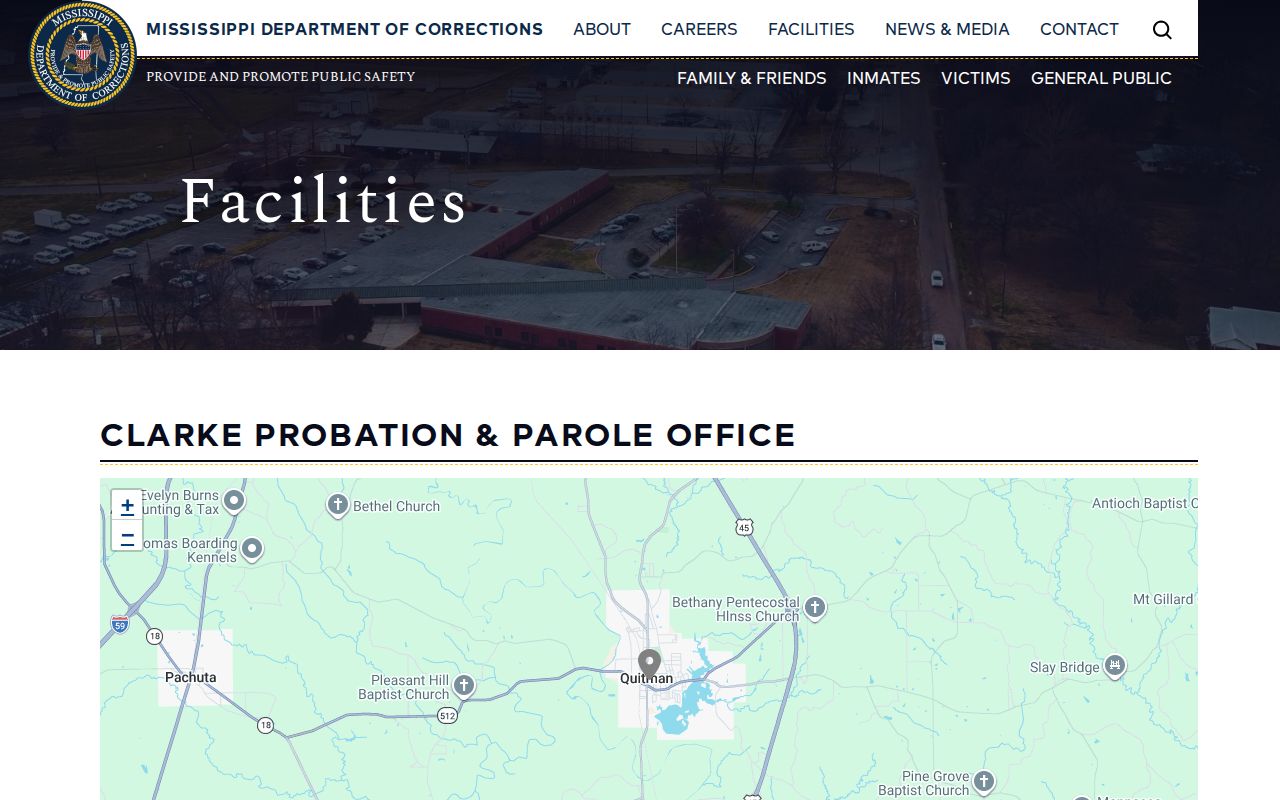
The office record supplies a Clarke-specific contact after a valid supervision match; it does not turn every local release into an MDOC case.
Clarke Supervision and Reentry
The local office creates a practical bridge between a statewide MDOC record and day-to-day supervision in Clarke County. MDOC's supervision material says an agent reviews residence approval and that an Interstate Compact process can move supervision between states. A person with a Clarke conviction may therefore report elsewhere. Likewise, a supervisee who lives in Clarke may have been convicted or released outside the county.
A county-specific Mississippi Reentry Guide directory can help locate local agencies and services for permitted personal navigation. Its entries should be checked with each provider because the directory was intermittently unavailable during research. The guide does not prove supervision, custody, or discharge. Use the MDOC and court records for those facts.
Clarke Supervision Violations
Conditions are the rules attached to a probation or parole term. Their exact wording comes from the judgment, Board action, and MDOC instructions. Common high-level subjects can include reporting, approved residence, travel, and compliance with court or agency directions, but only the person's own record states the binding terms. A violation allegation is not the same as a final finding.
An absconder is someone alleged to have failed to remain in required contact or location. A pending violation, bench warrant, or revocation action can lead to a return to custody. Clarke Circuit MEC uses flags that include probation-violation pending, PRS-violation pending, and bench-warrant states. Those flags describe court activity, not a complete public warrant list. No Clarke-specific public absconder or warrant list was verified.
Check the parolee record, then read the underlying court entry. Confirm any warrant through the responsible court or law-enforcement source. Mississippi SAVIN/VINE may report an escape, abscond-supervision event, or return to custody when a participating agency transmits it, yet that alert remains an event notice rather than the final court or MDOC decision.
Note: Silence in a parolee or court search does not establish that no warrant, violation, or supervision term exists.
Clarke Parole Decision Records
The Mississippi State Parole Board alone grants, denies, or revokes parole. MDOC supervises the person after release. Research found no official public person-by-person hearing calendar and no public person-by-person decisions database. A general agency page or news item should not be presented as either one.
The governing administrative rule requires parole-release hearings no later than thirty days before the month of eligibility, with time for people eligible in that month or the prior two months. MDOC also says an eligible-offender list is generated each month. That supports monthly case processing, but not a claim that the Board posts a public monthly calendar.
Eligibility depends on the sentence, offense, offense date, and statutes that apply to the individual case. Miss. Code §47-7-3 and related provisions set the main framework, while §47-7-3.2 includes different thresholds and exclusions for covered categories. Life terms, habitual-offender rules, sex offenses, trafficking offenses, and other case traits may require distinct treatment. A public tentative date or an estimated eligibility point cannot substitute for the Board's case status.
239 North Lamar Street, Suite 501
Jackson, MS 39202
Phone: 601-576-3520
Email: MSStateParoleBoard@mdoc.state.ms.us
Ask the Board for a specific case's status, decision, and effective date. Do not invent result categories or infer a grant from a projected date. Parole eligibility is only a point at which a case may be considered. It is not a promised release date. After a grant, confirm actual departure with MDOC Records or VINE and use the Parolee Search for the public supervision relationship.
Ending Clarke County Supervision
Supervision ends through a controlling court or agency action, not merely through the passage of an expected date. A probation order and later termination record establish the court side. For parole or other MDOC status, request the applicable completion or discharge documentation from MDOC Records. A discharge means the controlling obligation has ended. It is distinct from parole eligibility, release to parole, and a tentative prison date.
Use the MDOC contact directory for Records at P.O. Box 24388, Jackson, MS 39225, 601-933-2889, or MDOCRecordsDepartment@mdoc.state.ms.us. Ask for supervision dates, actual release or discharge date, release type, and a discharge certificate or other releasable document. Include the MDOC ID. If probation was court ordered, obtain the Clarke judgment and the order that ends or changes the term.
Completed supervision can explain why a person no longer appears in a live parolee search. Other explanations include a name mismatch, a different assigned county, data timing, or a type of probation not shown there. The absence should prompt a check of the underlying judgment and discharge record, not a conclusion about custody. A current court violation flag also needs the actual docket entry because a code alone does not disclose the final result.
Final verification is strongest when the sources agree: the sheriff or MDOC record shows actual movement, the court or Board record shows legal authority, and the supervision or discharge record shows the community status. Each source answers one part of the question.